
British Schools Need a Bolder Rethinking of 'Enrichment'
The Department for Education's Enrichment Framework could form the basis for a more ambitious reframing of the fundamental purpose of schooling.


Bridget Phillipson has made working class kids’ entitlement to high-quality enrichment activities a soap box issue for most of her tenure as Education Secretary. Visitors to her Sanctuary Buildings’ office report a scattering of independent schools’ glossy brochures featuring the sorts of sporting, artistic and other opportunities that have come to mark the divide between fee-paying and state-funded education. Why, Phillipson has been known to ask visitors, aren’t these opportunities available for all students?
She is right to ask. The benefits of enrichment activities have been clear for generations, as have the costs of missing out. The Social Mobility Commission broke no new ground in 2019 when it concluded that students’ achievement, attendance, willingness to remain in education, and overall wellbeing were all highly positively affected by participation in a wide range of enrichment activities. The Commission also noted: “Wide parts of life experience gained from extracurricular activities are unavailable for the most marginalised groups in society.”
The intervening years have encompassed the AI ‘singularity’, a development which may yet prove singularly bad for child development. The prospect of liberating children from excessive screen time and cognitive and creative ‘offloading’ adds urgency to the call for schools to provide enriching activities that contribute to a more intentional childhood.
Last November, Phillipson announced "a new enrichment entitlement for all that includes civic engagement, culture, nature and adventure, and sport" as minimum requirements. To underline the importance of these aspects of schooling, she said they would be formally assessed by Ofsted. The subsequent schools white paper doubled down on that commitment by promising an Enrichment Framework for schools. Unusually for government guidance, the Framework itself was released on time in June. The Framework includes eight benchmarks for Enrichment activities for all schools and, to the authors’ credit, includes case studies from across primary, secondary, special needs and alternative education.1
Wide variations
Statutory guidance, in order to be workable, aims to set a minimum standard for provision. Typically, it also shines a light on the diversity of practice across schools, stimulating debate and, hopefully, a degree of healthy ‘consumer’ pressure. So it has proven with Enrichment for All.
Research by SchoolDash suggests that the number and nature of clubs differ widely across the country. SchoolDash found that the (mean) average school offered 13 different types of club, but the range of activities varied in lockstep with other factors. Bigger schools in towns and cities, and schools with sixth forms, tended to offer the widest range of clubs. So did those with higher proportions of ethnic-minority pupils. Grammar schools tended to have a wider variety of enrichment clubs than other types of state-funded schools, in part reflective of their more middle class parent communities.
In general, the breadth of enrichment activities, as well as the type of activity offered from school to school, was inversely correlated with its level of deprivation (see graph below). The challenge of raising students’ attainment to levels needed to remain in education or training tended to consume most of the energy in schools working in poorer communities with lower attainment on entry. These schools tended to score highly for breakfast, cooking and homework clubs—though only one of these can fairly be called ‘enrichment’ at all.
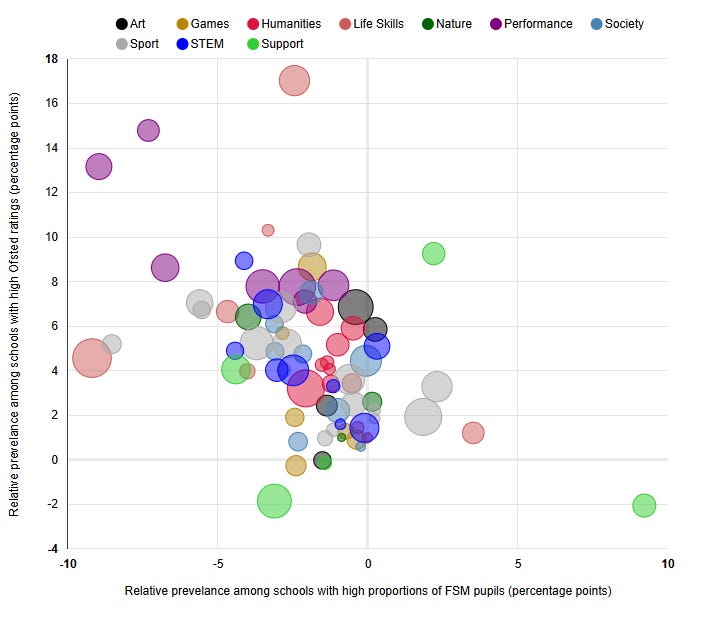
Schools in more affluent communities had more scope to focus on other things: art, debating, computer science and university clubs. Readers familiar with the schools landscape will already have derived the regional implications of these statements: schools in London and the South East tended to offer a significantly wider range of activities than those elsewhere in the country.
Differences in the type of enrichment activities on offer also reflected school ethos. Catholic schools, for example, offered a wide range of musical opportunities but were not generally places where one could find thriving societies devoted to LGBTQ issues.
Partnerships, funding
Natural supporters of the Labour government will likely be reassured by the Framework’s sensitivity to place and to context, but rattled by its implicit admission that some schools will continue to do much more than others. An example of the latter is the Framework’s acknowledgement that schools aiming to offer the richest enrichment programmes will require philanthropic as well as public funding and likely also partnerships with other types of organisations. Neither philanthropic capital nor strong partner organisations are evenly distributed around the country.
The Enrichment Framework is an overwhelmingly positive piece of work, well targeted and sensibly framed. I will not be alone in pointing out the lack of substantial dedicated funding to support schools in implementing its recommendations. This is not, sadly, a return to the Extended Schools Programme of the early 2000s–blown apart in 2011 by an opening salvo in the Coalition government’s austerity barrage. More constructively, however, there are four points I will offer as EBIs.
I admire the Framework’s openness about the need for external support, including financial support to mount a truly excellent Enrichment programme. But, if we are to be candid, not all school leaders are equally good at working with philanthropists or partner organisations. My own school, the London Academy of Excellence, operates one of the widest enrichment programmes in the country at our phase of education. We have tried to be open about the debt that owes to generous philanthropic support. Some of those partners came to us having exhausted attempts to work constructively with other schools. Best practice guidelines for partnership working sitting alongside the Enrichment Framework would have been a welcome addition.2
Children’s wellbeing could be weighted more heavily in the overall index of Enrichment benefits. Notwithstanding the Education Secretary’s personal record as a footballer and hockey player, not to mention her well-advertised support of Houghton Rugby Club, there is nothing here to match the French government’s requirement that all schools host sporting associations that offer students up to three additional hours of extra-curricular sport (sport scolaire). In the current climate, this seems to carry too high an opportunity cost.
The independent sector has been overlooked as a valuable, if not unique, source of best practice. For decades and in some cases centuries, independent schools’ reputation and self-understanding rested on their co-curricular programmes (no-one would think to use a term such as ‘Enrichment’, which implies ‘extra’). Some of these programmes will remain too culturally distinct, others simply too expensive for most state-funded schools. But assuming their irrelevance ipso facto seems more a function of ideology than of practicality.
Finally, the Framework could have been embraced more tightly and championed more boldly as an opportunity to re-assert the value of holistic schooling. The occasional intrusion into the Framework of bureaucratic phrases such as ‘non-examined activity’ reinforces the deeply-planted assumption that schools remain primarily qualification factories rather than places where the next generation is responsibly and joyfully inducted into the culture. Parents of all backgrounds consistently express their support for this more ambitious vision. Recovering this sense of schools’ fundamental role should be central to any conversation about Enrichment.
These are, in fact, the majority of the report.
I will return to this topic in a forthcoming post.
The inverse correlation between deprivation and enrichment breadth is the central problem the Framework needs to solve, and acknowledging that philanthropic and partnership support is required while knowing that neither is evenly distributed is essentially admitting the policy cannot deliver equity without the funding to match the ambition. What would it mean to treat enrichment not as an enhancement to the curriculum but as a core entitlement that attracts protected resourcing in the same way that literacy and numeracy do?
Only to say I agree 100% with this analysis and viewpoint.