
Specialism and Support, Not Selection, Drives Student Success
It is high time to dispell the fog of confusion around what drives student success in the later stages of secondary education.


I routinely draw on my own experience in writing this Substack but, to avoid being too nauseating, I don’t generally write about myself or my school. Events in the past week have changed the equation.
The school I lead, the London Academy of Excellence (LAE), has been doused by a firehose of publicity since we announced that more than one-in-four of our students received an offer to study at Oxford or Cambridge. For a predominantly state-funded school, this is a virtually unprecedented achievement.1
The Times published a front-page news story about us, wrote a leader article suggesting that our school should be cloned elsewhere in Britain, and followed up with a feature to appear in its weekend magazine. The BBC and various other news sites, radio talk shows and television news programmes also stopped by. To cap things off, former Prime Minister Lord Cameron celebrated our students’ success as proof of the value of education policies inherited from Sir Tony Blair and expanded by his own administration. Those policies are not in favour with the current Labour government.2
When I started this Substack, I noted with regret that no education practice is without controversy, no policy without overtones of wider ideological affinity. So it has proved in the past fortnight. Almost no commentator has failed to find confirmation of their pre-existing biases in the story of 62 hard-working teenagers—the vast majority from working class homes—who now have the opportunity to attend one of the world’s leading universities.
From my perspective, the most striking features of this commentary, be it positive or negative, is how singularly focused it is on the totemic principle of selection in schools and how rarely it coincides with the reality of schooling, either at the LAE or elsewhere in Britain.
What’s not to like?
Let’s start with the controversy. One commentator—I won’t use names—bemoaned the effect of our type of school in “removing students from their communities”. A moment’s pause to consider the staggering insensitivity of rendering judgement on young people none of whom they had ever met might have been in order. No matter. An LAE alumnus interjected to point out that this characterisation was far removed from his own experience or that of any of his friends.
Another writer suggested that the problem with educating young people from working class families to a high standard is that they might choose to leave the places in which they grew up. There is a serious point here—albeit well hidden—relating to the need for economic regeneration to run parallel with educational improvement in parts of Britain where graduate opportunities are scarce. To be fair to the original author, as a London school, we do not face this particular challenge.
However, the moral point at issue should be abundantly clear: any educator who thinks it legitimate to withhold educational opportunity from young people, anticipating that they may not approve of how that opportunity is used, has no business calling themselves an educator at all.
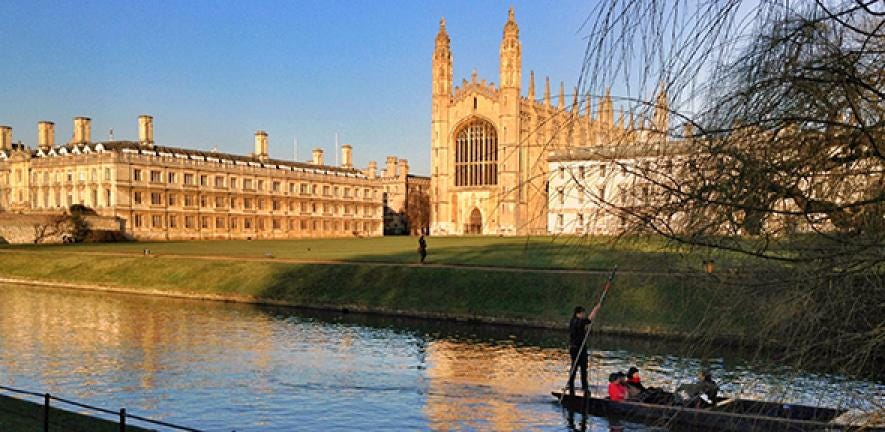
Thirty-nine LAE students hold offers to study at the University of Cambridge (pictured).
Most common and most telling is the refrain that pits institutional interest against students’ interest. Schools like ours damage “other strong schools” by acting as a magnet for bright, ambitious students, one education leader wrote. Never mind the fact that the London Borough of Newham was among the worst-performing education authorities in the capital when the LAE was founded here in 2012 and is now among the best in the country. (Not in any sense our achievement, but not unrelated to our existence.) In what sense are schools offering their students lesser opportunities “strong schools”?
Clearly, most of this criticism originates on the Left of the political spectrum. Most of our detractors would claim to oppose Neoliberalism, in education and in society more broadly. What’s perplexing, is that the tacit assumption that there is no wider social benefit to student success is itself a quintessentially Neoliberal position. It is also transparently false. One of the reasons LAE students are so successful is that the transformation in schooling in our part of East London has normalised the journey from council estate, to Oxford college, to corporate boardroom. Each of those individual stories represents a family and a community transformed.
Reality calling
Wherever one’s sympathies lie, to read any of the above comments absent context would lead one to conclude that selection at age 16 is unusual in the British schooling system. The reality is exactly the opposite. The LAE is a post-16 school that offers A levels. There is essentially no such thing as non-selective A level provision in England, Wales or Northern Ireland. All A Level courses have admissions criteria, almost always expressed as GCSE grades or grades in equivalent qualifications.3
This is for good reason. The evidence suggests that students who have not achieved well, meaning a so-called “strong pass”, a grade 5, in at least five GCSEs including English and maths, have virtually no chance of achieving well at A Level. Schools and colleges with more permissive admissions criteria than our own typically offer such students alternative courses with statistically greater chances of success.4
People can agree or disagree about whether or not our own admissions criteria are fair. We require applicants to have achieved grade 7 or above in eight GCSEs. This ‘entry tariff’ reflects our local context. We have the good fortune to operate in the area of England with the highest average student attainment at age 16. In 2025, the LAE received applications from over 6,300 students, more than 3,800 of whom met our admissions criteria. We had, at the time, 250 available places.5
The piece of this story that goes almost wholly unreported is the fact that the LAE’s success is a vindication of contextual recruitment in education. We do not—as our critics, and perhaps some of our supporters, seem to imagine—simply admit the students who achieve the highest grades. Instead, we first admit those who are eligible for free school meals. Only once those students are admitted do we start offering places more widely. (As I’ve previously argued, the government could require all schools to adopt this practice by changing the Schools Admissions Code.)
The impact of this on our student population is profound. Over the past few years, around 40 percent of our students have been admitted ahead of other applicants whose grades may have been better but whose parents were richer. Some people will find this practice unfair. Clearly, I do not. We have never sought to be a grammar school on the conventional model. Our mission is quite clearly to advance the life chances of students who have not typically benefited from an education of the type we offer.
The most important lesson that should be drawn from the LAE’s success, this year or any year, is that those students can do just as well as students from any other background when provided with enough support of the right kind.
What works?
The Times says my school is “unashamedly selective”. The Right is quite comfortable with selection. In fact, what we are is unashamedly specialist. We do one thing—prepare students to study at highly competitive universities, or to enter highly competitive degree apprenticeships (they are equivalent)—and do it well. This has benefits both in terms of staffing and in terms of student culture.
Our teachers are profoundly committed to their subjects. More than a third of them have PhDs. Almost everyone has a master’s degree in a subject they teach. Conversations over lunch in the staff room can take in semiotics, artificial intelligence and the ethics of gene editing. Such colleagues are—to be fully transparent—expensive. So our ability to attract philanthropic capital is an important buttress to our ability to specialise, given a national funding formula that encourages the opposite.
Specialism also enables us to gather together a community of students with common interests and common aspirations. The value of this peer network was made immediately clear when I first visited the school, more than five years ago, prior to my appointment. When I asked my student guides what they liked best about the LAE, both students, both of whom had attended local state schools, pointed to the community. “If I was stuck on a problem [in secondary school],” said one, “there was no-one who could help me work it out. Here, I’m surrounded all day long [by other students] who can help.”
What’s perhaps most significant about aversion to ‘selection’, however practiced, is that it applies only to academic study. There is no firestorm of controversy over football academies, music conservatories or drama schools. The literal practice of selection by try-out or audition is unproblematic in these cases. The rewards that accrue to elite performance in these fields provokes barely a murmur of criticism. The budding opera singer whose aspirations run higher than the Doncaster Playhouse attracts no-one’s opprobrium. The nation will take you to its heart if you are poor and sporty, or poor and musically gifted. ‘Know your place’ applies only if you happen to be poor and clever.
To be clear, I am not suggesting that any of this is a result of my personal input.
I don’t court publicity for its own sake or seek endorsements from any political party. A fair-minded observer would point out that Cameron’s sponsorship of academisation ran parallel to a programme of fiscal austerity that exposed schools to a wave of social need they were wholly under-resourced to meet. The same observer would also point out that the free schools programme, under which the LAE opened in 2012, had its share of failures as well as its successes.
This is sharply different from school admissions at age 11, where selection on academic criteria is confined to those counties that retain a grammar school system. Too few commentators seem alive to this distinction.
This is not to avoid the point that far too few students, particularly those from working class homes, achieve sufficiently well at age 16 to go on to study A levels. I wholly agree that this is a national scandal, but it is logically separate from the point that students need to be ready to take specific courses.
I’ve several times been asked whether I would set the same admissions criteria in parts of the country where attainment at 16 is lower. Obviously, I would not. The follow-up question is almost always: would students with lower grades on entry do as well as our students do currently? The answer to this question is equally obvious. No, most of them would not. This seems to me to miss the point. The point is that they would do better than they do in their current context.